

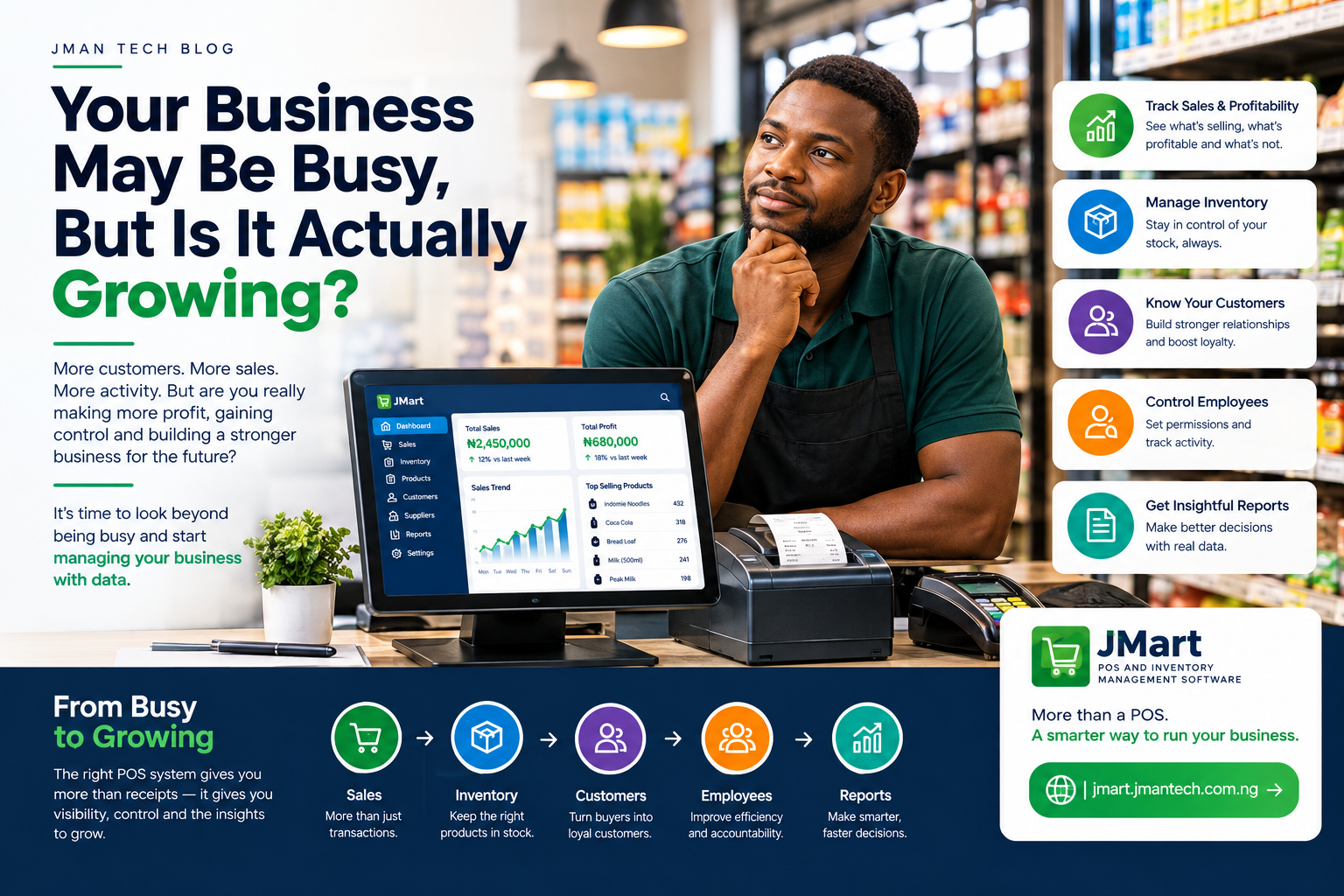
A busy business can look successful.
Customers are coming in. Employees are working. Products are moving. Money is entering the business. The phone is constantly ringing. The owner barely has time to sit down.
From the outside, everything looks fine.
But here's a question every business owner should occasionally ask:
Is my business actually growing, or am I simply staying busy?
There is a difference.
And understanding that difference can completely change the way you run your business.
Being Busy Is Not the Same as Growing
Imagine two business owners.
The first opens his store every morning, spends the entire day dealing with customers, supervises employees, handles suppliers, solves problems, checks stock, collects payments, and closes late at night.
He does this six days a week.
He is extremely busy.
The second business owner also has a busy store. But she spends part of her time looking at sales reports, analyzing inventory, reviewing expenses, identifying problems, planning purchases, and improving processes.
Both businesses may be generating revenue.
But they are not necessarily moving in the same direction.
One owner is working inside the business.
The other is increasingly managing the business.
That distinction matters.
Revenue Can Hide Problems
One of the easiest ways to convince yourself that your business is doing well is to look at revenue.
You made ₦5 million this month.
Then ₦6 million next month.
Then ₦7 million.
It feels like growth.
But what if your expenses increased even faster?
What if you sold ₦7 million worth of products but only kept a small percentage after the cost of inventory, salaries, rent, transportation, electricity, losses, and other expenses?
Your revenue increased. But your financial position may not have improved proportionally.
This is why business owners need to look beyond sales.
You need to understand:
Revenue → Costs → Gross Profit → Expenses → Net Profit
Sales are important.
But sales alone don't tell the whole story.
Are You Making More Money or Just Moving More Products?
This is especially important in retail.
Suppose you sell 10,000 units of products this month.
That's a lot of activity.
But if your margins are poor, selling more products doesn't automatically mean you're becoming more profitable.
Some products may generate significant revenue but very little profit.
Others may sell less frequently but have much better margins.
This is why business owners should understand their products beyond simply knowing which ones sell the most.
Ask:
- Which products generate the most revenue?
- Which generate the highest margins?
- Which products are barely moving?
- Which products tie up the most capital?
- Which products frequently run out?
- Which products are causing losses?
The best-selling product isn't necessarily your most valuable product.
Your Inventory Could Be Telling You Something
Walk into your store.
Look around.
Everything appears normal.
But your shelves contain thousands or millions of naira worth of inventory.
How much of it is actually moving?
Some products may sell every day. Others may have been sitting there for months.
That means some of your money is effectively frozen in inventory.
A business can therefore have:
A full store but an empty bank account.
This is one of the reasons inventory management is so important.
The goal isn't simply to have plenty of products.
The goal is to have the right products in the right quantities at the right time.
What Happens When the Owner Doesn't Know the Numbers?
Consider a business owner who cannot quickly answer these questions:
- How much did we sell yesterday?
- How much did we make this month?
- What are our most profitable products?
- What products are running low?
- How much inventory do we currently have?
- How much money is tied up in stock?
- How much do customers owe us?
- Which employee processed the most sales?
- What are our biggest expenses?
- Are our margins improving or getting worse?
If answering these questions requires searching through notebooks, spreadsheets, receipts, WhatsApp messages, bank statements, and asking several employees, there is a deeper problem.
The business may be generating information.
But the owner doesn't have visibility.
And without visibility, decision-making becomes guesswork.
Running a Business on Memory Is Dangerous
Small business owners are often forced to remember a lot.
They remember which supplier owes them something. They remember which customer hasn't paid. They remember which product sells quickly. They remember which employee handled a particular transaction. They remember roughly how much stock is left.
They remember what happened last month.
But human memory isn't a business database.
As the business grows, the amount of information becomes too large for one person's memory to handle reliably.
This is where systems become important.
Instead of:
"I think we sold a lot of this last month."
You should be able to see the numbers.
Instead of:
"I think we're running low."
You should be able to see the stock level.
Instead of:
"I think our sales are improving."
You should be able to compare the periods.
Good business decisions become easier when good information is available.
Growth Should Reduce Chaos, Not Increase It
Here's another interesting question:
As your business grows, does your life become easier or more chaotic?
If doubling your sales means doubling your confusion, you may have a process problem.
Imagine a supermarket growing from:
1 cashier → 3 cashiers → 8 cashiers
Or:
500 products → 2,000 products → 10,000 products
Or:
1 location → 3 branches → 8 branches
You cannot expect the same manual processes that worked at the beginning to continue working indefinitely.
Growth creates complexity.
And complexity requires systems.
The Business Should Not Depend Entirely on the Owner
This is one of the hardest transitions for many entrepreneurs.
In the early days, the owner does everything.
You know every product. You know every customer. You know every supplier. You know how much money is coming in. You know what happened yesterday.
But eventually, the business becomes too large for one person to personally control everything.
At that point, the goal should be to build systems that allow the business to operate reliably even when the owner isn't standing over everyone.
That means having:
- Clear processes
- Reliable records
- Employee permissions
- Inventory controls
- Financial records
- Sales reports
- Audit trails
- Defined responsibilities
The goal isn't to remove the owner from the business completely.
The goal is to make the business less dependent on the owner's memory and physical presence.
Technology Is Not the Goal
This doesn't mean every business needs to buy expensive software.
Technology itself doesn't make a business successful.
A poorly managed business with expensive software is still a poorly managed business.
The purpose of technology is to solve problems.
For example:
- If you're losing track of inventory, use technology to improve inventory visibility.
- If you don't know what products are profitable, use data and reporting to analyze margins.
- If employees have too much uncontrolled access, use role-based permissions.
- If you're struggling to manage multiple branches, use centralized systems.
- If you're spending hours preparing reports manually, automate them.
Don't buy software because everyone else is buying software.
Buy or build systems because there is a problem you need to solve.
Your Business Is Producing Data Every Day
Every day, your business generates information.
A customer buys something.
A supplier delivers stock.
An employee processes a transaction.
A product is returned.
A customer takes goods on credit.
A product reaches its reorder level.
An expense is paid.
A branch transfers inventory.
These aren't just events.
They are data points.
And when those data points are captured properly, they can tell you a story about your business.
They can show you trends.
They can reveal problems.
They can highlight opportunities.
They can help you plan.
This is one of the biggest differences between simply running transactions and managing a business with data.
Ask Yourself These 10 Questions
Before you finish reading this article, ask yourself:
- Do I know exactly how much my business sold last month?
- Do I know exactly how much profit we generated?
- Do I know which products generate the highest margins?
- Do I know which products are sitting too long in inventory?
- Do I know which products are approaching stock-out?
- Can I track important employee activities?
- Can I quickly identify unusual transactions or inventory changes?
- Can I see what's happening across all my branches?
- Can my business continue operating effectively when I'm not physically present?
- Am I making decisions based on actual data or mostly on intuition?
If you can't answer several of these questions, don't panic.
It simply means there may be an opportunity to improve how your business is managed.
The Real Definition of Growth
Growth isn't simply:
More customers.
It isn't simply:
More sales.
It isn't simply:
More employees.
And it certainly isn't simply:
More work.
Healthy business growth should ideally mean that the business is becoming more capable.
- More revenue.
- Better margins.
- Better processes.
- Better visibility.
- Better customer retention.
- Better inventory management.
- Better financial control.
- Better systems.
And ideally, greater ability to operate without everything depending on one person.
From Busy Business to Managed Business
This is where business management software can become valuable.
A modern system can bring different parts of the business together:
Sales. Inventory. Customers. Suppliers. Employees. Purchasing. Accounting. Reports.
Instead of having information scattered across notebooks, spreadsheets, receipts, and different applications, a connected system can provide a central view of the business.
That doesn't replace good management.
It gives management better information to work with.
JMart: Turning Business Activity Into Useful Information
At Jman Tech, this is part of the thinking behind JMart.
JMart isn't designed simply to record sales and print receipts.
It connects areas such as sales, inventory, products, customers, suppliers, purchasing, users, reporting, and business data.
The objective is simple:
Help businesses move from merely recording transactions to understanding their operations.
For businesses operating in environments where internet connectivity can be unreliable, JMart is also designed to work offline and synchronize data when connectivity is restored.
You can learn more about JMart POS and Inventory Management Software .
Final Thought
The next time you look at your business and think:
"We're very busy."
Stop for a moment.
Then ask:
"But are we actually getting better?"
Are your margins improving?
Is your inventory becoming more efficient?
Are your processes becoming more organized?
Are you gaining better control?
Are you making decisions with better information?
Is the business becoming less dependent on you personally?
Because there is a big difference between a business that keeps you busy and a business that keeps getting better.
Don't measure your business only by how much work it creates. Measure it by how much value, control, efficiency, and profit it creates.