


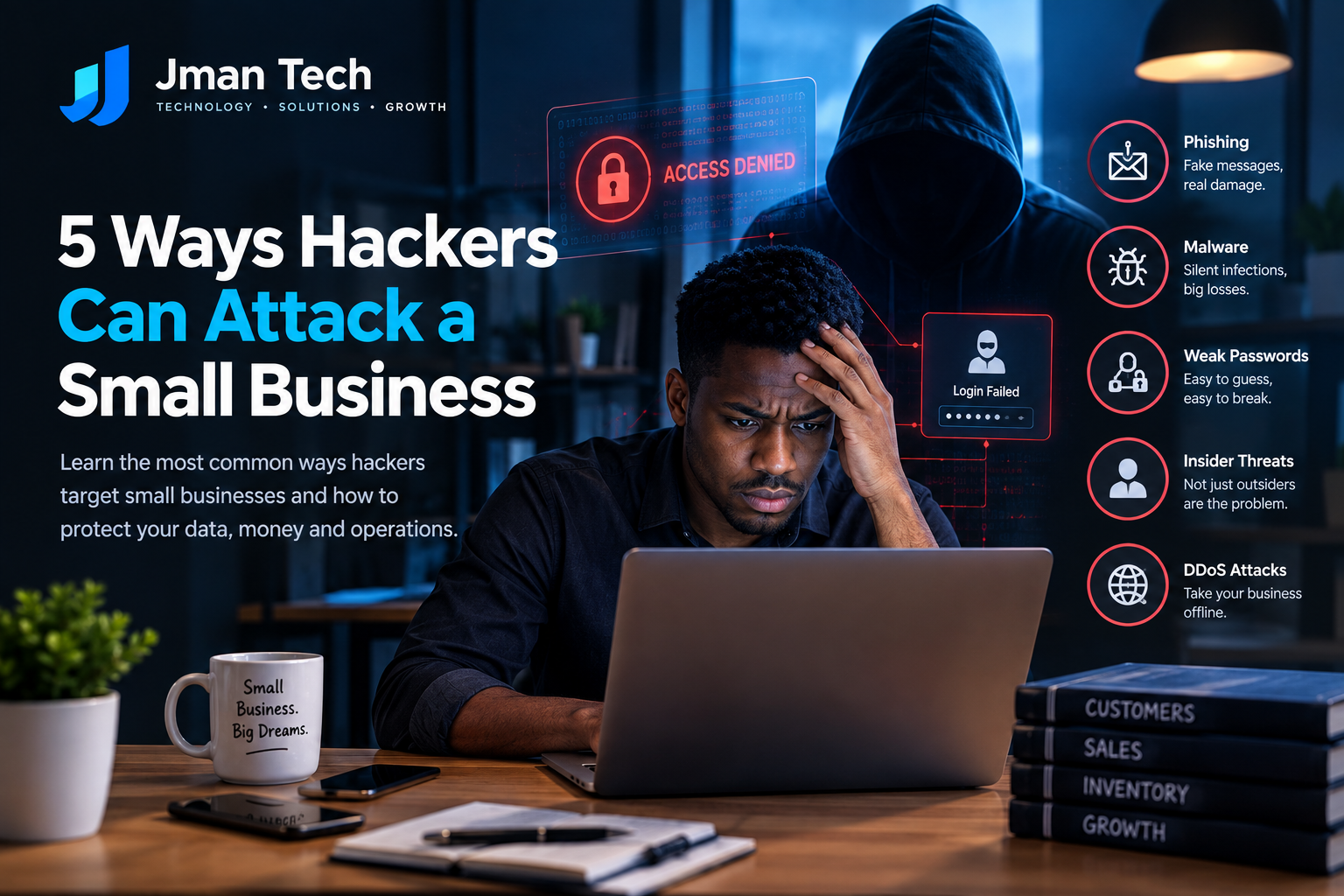
Many small business owners believe hackers only target banks, governments and multinational companies.
Unfortunately, that's a dangerous myth.
Small businesses are among the most common victims of cyber attacks because they often have valuable customer data, payment information and business records—but fewer security measures than larger organizations.
A successful attack can cost far more than money. It can damage your reputation, interrupt your operations and destroy years of customer trust.
Here are five of the most common ways hackers attack small businesses, and what you can do to protect yourself.
1. Phishing Emails: The Attack That Looks Legitimate
Phishing is one of the easiest and most effective ways hackers steal information.
Instead of breaking into your computer, they trick you into opening the door yourself.
You receive what appears to be an email from your bank, a supplier, DHL, or even your accountant. The message usually creates urgency:
- Your account has been suspended.
- Click here to confirm payment.
- Your invoice is attached.
- Your password expires today.
One careless click can reveal your login details or install malicious software.
How to protect your business
- Verify unexpected emails before clicking links.
- Check the sender's address carefully.
- Never enter passwords through email links.
- Train employees to recognize phishing attempts.
2. Weak Passwords: The Open Front Door
Many businesses still use passwords like 123456, password, or the company's name.
Hackers use automated software that can test millions of password combinations within minutes.
Even worse, many people reuse the same password for email, banking, cloud storage and business software. If one account is compromised, several others may follow.
How to protect your business
- Use long, unique passwords for every account.
- Enable two-factor authentication (2FA).
- Use a password manager instead of writing passwords in notebooks.
- Never share business passwords through WhatsApp or SMS.
3. Malware & Ransomware: When Your Files Become Hostage
Malware is malicious software designed to damage or spy on computers.
Ransomware is even more dangerous. It encrypts your business files and demands payment before you can access them again.
Imagine arriving at work and discovering that every customer invoice, accounting record and inventory file has been locked.
For many businesses, that could bring operations to a complete stop.
How to protect your business
- Keep Windows and your software updated.
- Install trusted antivirus protection.
- Back up important business data regularly.
- Don't install pirated or untrusted software.
4. Insider Threats: Not Every Risk Comes From Outside
Cybersecurity isn't only about anonymous hackers wearing hoodies.
Sometimes the biggest risk comes from inside the business.
An employee might accidentally delete important records, share sensitive information, use unauthorized USB drives, or reveal passwords without realizing the consequences.
Most insider incidents are caused by poor processes rather than bad intentions.
How to protect your business
- Give employees only the access they actually need.
- Keep audit logs of important actions.
- Remove access immediately when staff leave.
- Provide regular cybersecurity awareness training.
5. Public Wi-Fi & Fake Networks
Working from cafés, hotels and airports has become common, but public Wi-Fi introduces additional risk.
Hackers sometimes create fake wireless networks with names that look legitimate, hoping unsuspecting users will connect.
If sensitive business activities are performed over insecure networks, valuable information may be exposed.
How to protect your business
- Avoid accessing banking on public Wi-Fi.
- Use trusted mobile data for sensitive work.
- Use a VPN when appropriate.
- Confirm the correct Wi-Fi network before connecting.
Why Small Businesses Are Attractive Targets
Hackers don't always chase the biggest companies. They often look for the easiest targets.
A small business may have:
- Customer databases
- Payment records
- Employee information
- Supplier accounts
- Business bank access
- Years of financial documents
That's valuable information, and protecting it is part of protecting your business itself.
5 Security Habits Every Business Should Adopt
- Enable two-factor authentication on important accounts.
- Use different passwords for every business service.
- Back up critical data automatically.
- Keep computers and software updated.
- Train every employee to recognize suspicious emails.
Final Thoughts
You don't need to become a cybersecurity expert to make your business significantly safer.
Most successful cyber attacks exploit simple mistakes—a weak password, an outdated computer, or a convincing fake email.
Building good security habits today is far less expensive than recovering from a cyber attack tomorrow.
Jman Tech helps businesses embrace technology securely—from business software and cloud solutions to digital tools that support growth and resilience.