


Walk into many retail businesses and you'll find two different systems running the same business.
One records sales.
The other records accounting.
At the end of every day—or sometimes every week—someone manually transfers figures from the POS into accounting software.
Sales are copied. Expenses are entered again. Inventory is adjusted separately. Bank deposits are reconciled manually.
It works.
But it's slow, repetitive and full of opportunities for mistakes.
The biggest question isn't "Can my POS print receipts?"
It's this:
Why should I enter the same business information twice?
Modern business software is changing that idea by bringing sales, inventory and accounting into one connected system.
What Does Accounting Actually Mean?
Many people think accounting is simply bookkeeping.
In reality, accounting is the process of recording, organizing and understanding the financial activities of a business.
Every sale affects your revenue. Every purchase affects inventory. Every expense reduces profit. Every payment changes your cash position.
Accounting connects all of these events into meaningful financial information.
The Problem With Separate Systems
Imagine your supermarket makes 450 sales today.
Your POS knows exactly what happened.
- Products sold
- Quantities
- Cash received
- Card payments
- Discounts
- Returns
- Inventory movement
Now imagine opening another accounting application and typing much of that information again.
That's duplicated work.
And duplicated work usually creates duplicated mistakes.
Every Sale Is Already an Accounting Transaction
Here's something many business owners don't realize:
A sales transaction is already an accounting event.
Suppose you sell cooking oil for ₦12,000.
Behind that single sale, several financial things happen automatically.
- Revenue increases.
- Inventory decreases.
- Cost of goods sold is recorded.
- Gross profit changes.
- Cash or bank balance increases.
The cashier shouldn't need to understand journal entries for the business to keep accurate records.
The software should do that work in the background.
Why Inventory and Accounting Belong Together
Inventory isn't just products on shelves.
It's money.
When you purchase stock worth ₦2 million, your business hasn't lost ₦2 million.
It has converted cash into inventory.
As products sell, inventory gradually becomes revenue and profit.
That's why inventory and accounting should communicate continuously.
Without that connection, it's difficult to know your true financial position.
Reports Every Business Owner Should See
A modern accounting system shouldn't overwhelm business owners with accounting jargon.
Instead, it should answer practical questions.
- How much did we sell today?
- What was our gross profit?
- Which expenses increased this month?
- How much do customers owe us?
- Which suppliers do we owe?
- What is our current cash position?
- How much inventory do we own?
- Are we actually making money?
These aren't accounting questions.
They're business questions.
Accounting Should Be Understandable
Traditional accounting software is incredibly powerful.
But many small business owners find it intimidating because it was originally designed with accountants in mind.
Terms like:
- General Ledger
- Trial Balance
- Double Entry
- Journal Posting
- Chart of Accounts
are important, but they can feel overwhelming to someone whose priority is simply running a supermarket or retail business.
Good software should hide the complexity—not remove proper accounting.
The business owner should see meaningful financial insights while the accounting engine quietly maintains accurate books behind the scenes.
What Should Happen Automatically?
Imagine a system where these events happen without manual bookkeeping:
| Business Activity | Automatic Accounting |
|---|---|
| Product sold | Revenue, inventory and profit updated |
| Stock received | Inventory value increases |
| Expense paid | Expense account updated |
| Customer pays debt | Receivables reduced |
| Supplier paid | Payables updated |
| Cash deposited | Cash and bank records synchronized |
That's what integrated accounting looks like.
Why Business Owners Need Financial Visibility
Revenue alone doesn't tell you whether your business is healthy.
Imagine these two businesses:
Business A
- Sales: ₦12 million
- Profit: ₦400,000
Business B
- Sales: ₦8 million
- Profit: ₦1.8 million
The larger revenue doesn't necessarily mean the healthier business.
That's why business owners need more than sales reports.
They need financial visibility.
Accounting Without Feeling Like Accounting
One of the biggest challenges facing small businesses is that accounting often feels like something you do after business hours.
Sales happen during the day.
Accounting happens later.
Modern software should eliminate that separation.
Every transaction should quietly build your financial records while you focus on serving customers.
Where JMart Fits In
At Jman Tech, this philosophy shaped how we built JMart.
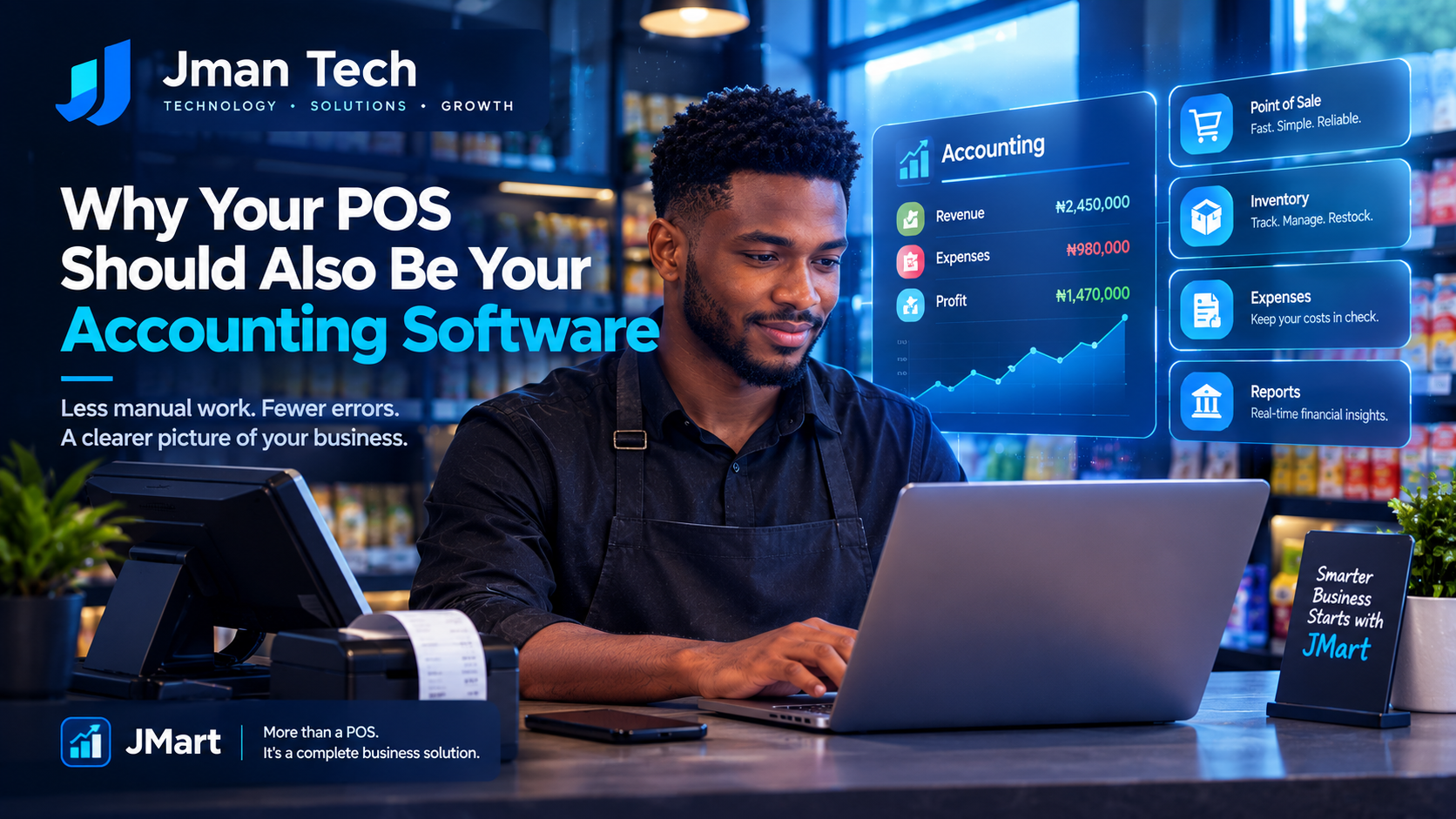
JMart isn't just a Point of Sale system. It's designed as a complete retail management and accounting platform for growing businesses.
Behind every sale, JMart automatically maintains accounting records, updates inventory, tracks expenses, manages credit customers, records supplier transactions and generates financial reports—all from the same system.
Instead of asking business owners to become accountants, JMart is designed to make accounting feel natural.
The familiar accounting engine is still there—ledgers, journals, trial balance, profit and loss, balance sheet and other financial records—but the everyday experience is built around how retailers actually operate.
That means less manual data entry, fewer duplicated records and a clearer understanding of your business without jumping between multiple applications.
Final Thoughts
A POS records transactions.
An accounting system explains what those transactions mean.
The future of retail software is bringing those two worlds together.
Because business owners shouldn't spend their evenings copying figures from one system into another. They should spend that time making better decisions.
The best accounting software isn't the one with the most complicated menus. It's the one that helps you understand your business with the least friction.
That's the direction JMart was built for: a platform where selling, inventory and accounting work together as one complete business system.