

You probably use cloud computing every day without thinking about it.
Your emails, Google Drive files, online banking, Netflix account, WhatsApp backups, business applications and many of the websites you visit rely on computers and servers somewhere on the internet.
But what exactly does "the cloud" mean?
And more importantly, why should a business owner care?
Cloud computing has changed how businesses store information, run software, collaborate and scale their operations. It allows businesses to use computing resources without necessarily owning and maintaining all the physical hardware required to provide them.
So, What Exactly Is Cloud Computing?
In simple terms, cloud computing means using computing resources over the internet instead of relying entirely on computers and servers physically located at your business.
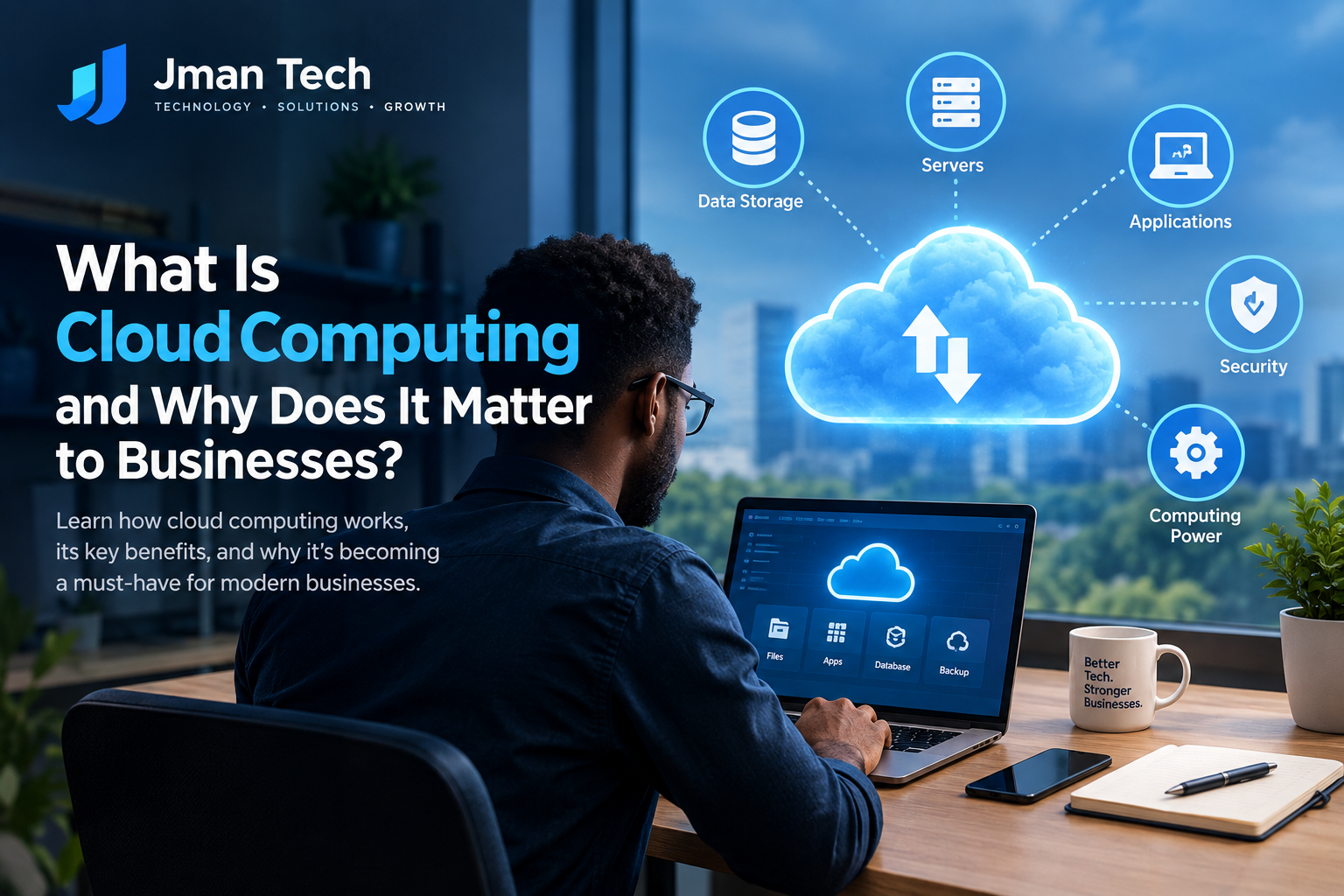
Those resources can include:
- File storage
- Databases
- Servers
- Software applications
- Computing power
- Data backup
- Artificial intelligence services
For example, instead of buying a powerful server, installing it in your office, maintaining it, replacing failed components and worrying about its power supply, a business can rent computing resources from a cloud provider and access them through the internet.
That is the basic idea behind cloud computing.
Why Is It Called "The Cloud"?
There is nothing mysterious floating in the sky.
"The cloud" is simply a convenient way of referring to remote computing infrastructure that you access through a network, usually the internet.
Somewhere in the world, there are physical data centres containing thousands of servers. Those servers store data and run applications.
You don't necessarily need to know where those servers are located. You simply connect to the service and use the computing resources you need.
Cloud Computing vs Traditional Computing
Imagine a small business running its accounting system entirely from one computer in the office.
The data is stored on that machine. The software runs there. If the computer fails and there is no reliable backup, the business could have a serious problem.
Now imagine that the business uses a cloud-based accounting system.
The application and its data can be hosted on remote infrastructure and accessed from authorized devices over the internet.
The business is no longer dependent on one physical computer for everything.
That difference can completely change how a business operates.
1. Access Your Business From Almost Anywhere
One of the biggest advantages of cloud computing is accessibility.
When a business application is designed for cloud access, authorized users can potentially access it from different locations and devices.
An owner could review business information from home. A manager could monitor operations from another branch. A team could collaborate on documents without everyone sitting in the same office.
The exact level of access depends on the software, permissions and security controls involved.
2. Businesses Can Reduce Hardware Dependence
Running your own infrastructure can require significant investment.
Servers need physical space. They consume electricity. They require maintenance. Hardware eventually becomes outdated or fails.
Cloud computing allows businesses to consume infrastructure as a service rather than necessarily purchasing and maintaining all of it themselves.
Instead of thinking only in terms of "Which server should we buy?", businesses can increasingly think in terms of "How much computing capacity do we actually need?"
3. Scaling Becomes Easier
A business that grows from 10 employees to 100 employees may need significantly more computing resources.
With traditional infrastructure, increasing capacity might mean purchasing, installing and configuring additional hardware.
Cloud platforms are designed to make it easier to increase or decrease resources according to demand, although the exact process and cost depend on the provider and architecture.
This flexibility is particularly useful for businesses experiencing rapid growth or unpredictable demand.
4. Collaboration Becomes Easier
Think about how businesses worked before cloud-based collaboration tools became common.
Files could be stored on individual computers, transferred using flash drives, attached to emails or kept on local servers.
Cloud-based tools changed that workflow.
Multiple people can work with shared documents, communicate through online platforms and access company resources without necessarily being in the same physical location.
For businesses with remote employees, multiple branches or distributed teams, this can be particularly valuable.
5. Backup and Disaster Recovery
Imagine losing your business computer tomorrow.
What happens to your customer records, financial documents, invoices, contracts and other important information?
Hardware can fail. Computers can be stolen. Offices can experience fire, flooding or other physical damage.
Cloud services can form part of a business's backup and disaster-recovery strategy by keeping copies of information away from the primary physical location.
However, cloud storage should not automatically be confused with a complete backup strategy. Businesses still need appropriate backup policies, security controls and recovery procedures.
6. Cloud Computing Is Behind Many Modern Business Tools
Cloud computing isn't just about storing files.
Modern businesses use cloud infrastructure for things such as:
- Accounting software
- Customer relationship management
- Inventory management
- Business intelligence
- Websites and online stores
- Communication platforms
- Data analytics
- Artificial intelligence
- Online payments
- Business backups
In many cases, the business owner doesn't even know which cloud infrastructure powers the software they are using.
Does Cloud Mean Your Business Needs Internet for Everything?
Not necessarily.
This is an important distinction.
A cloud-based application generally relies on internet connectivity to communicate with its cloud services. However, some applications can also provide offline functionality and synchronize information when connectivity is restored.
This means businesses don't necessarily have to choose between "cloud" and "offline."
Modern software can be designed to combine both approaches depending on the business's requirements.
But Cloud Computing Isn't Perfect
Cloud computing provides significant advantages, but it is not automatically the right solution for every situation.
Businesses need to consider:
- Internet connectivity
- Security
- Data privacy
- Service availability
- Vendor dependence
- Ongoing subscription costs
- Data backup and recovery
- User access and permissions
Moving a business to the cloud without understanding these issues can simply replace one set of problems with another.
What Does Cloud Computing Mean for a Small Business?
You don't need to be a large corporation to benefit from cloud technology.
A small retailer might use cloud-based accounting software.
A growing company might use cloud-based collaboration tools.
An online business might host its entire website and database in the cloud.
A startup might use cloud infrastructure instead of purchasing expensive servers before it even has enough customers to justify them.
This is one of the biggest changes cloud computing has brought to technology: access to computing infrastructure is no longer limited to businesses with large IT departments and huge hardware budgets.
The Bigger Picture
Cloud computing is more than a technology trend.
It represents a shift in how businesses think about technology.
Instead of every company having to own and maintain every piece of technology it needs, businesses can increasingly consume computing power, storage, software and other digital services when they need them.
And this shift is making it possible for smaller businesses to use technologies that once required significant infrastructure and technical expertise.
The cloud isn't just changing where businesses store their data. It is changing how businesses use technology.
Final Thought
The next time you open a document from your phone, check your business dashboard from another location, send an email or use an online business application, remember that you are probably already using cloud computing.
The real question for businesses is no longer whether cloud computing exists.
The question is:
How can we use it to build a more efficient, flexible and resilient business?
At Jman Tech, we build software and digital solutions designed to help businesses use technology to solve real-world problems.
Whether it's business management software, automation, custom applications or other technology solutions, the goal is the same: use technology to make business operations smarter and more efficient.